
Exosome Hair Treatment for Hair Loss & Thinning: What the Science Says
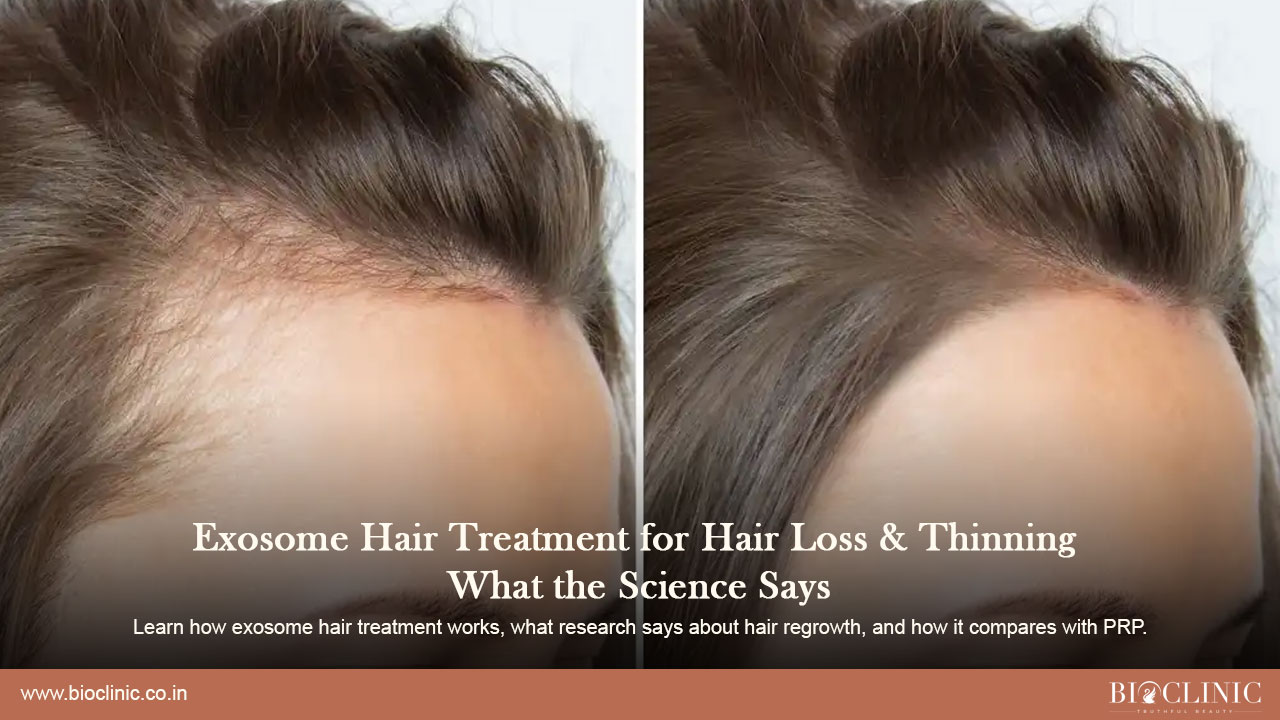
Exosome Hair Treatment: How It Works for Hair Loss and Hair Thinning
Most people don't notice hair thinning the day it starts. It shows up slowly — a wider parting, a ponytail that feels thinner than it used to, more strands on the pillow than seems reasonable. By the time it becomes a topic of conversation, many people have already tried the obvious fixes: a change in shampoo, a multivitamin, maybe minoxidil from the pharmacy. Somewhere in that search, a newer term tends to surface — exosome hair treatment — usually mentioned alongside PRP and other regenerative options at aesthetic clinics.
It's a treatment that sits at an interesting point right now: genuinely promising in early research, but still short on the kind of large, long-term human trials that would let anyone call it settled science. Understanding what it actually is — and what it isn't — matters more than the marketing around it suggests.
What exosomes actually are
Exosomes are not stem cells, even though they're often discussed in the same breath. They're tiny extracellular vesicles — think of them as microscopic message carriers — released by cells, including stem cells, as a way of communicating with other cells nearby. Each exosome carries a payload of proteins, growth factors, and genetic material (like microRNA) that can influence how a receiving cell behaves.
In the context of hair, researchers are interested in exosomes because of the signals they may deliver to the hair follicle: cues involved in cell growth, blood vessel formation, and inflammation control. The proposed mechanism involves signaling pathways such as Wnt/β-catenin, VEGF, and TGF-β, all of which play a role in whether a follicle is actively growing hair or sitting dormant [source].
Its worth being precise here, because the word "exosome" gets used loosely in marketing. Exosomes can be derived from different sources — commonly mesenchymal stem cells (often from adipose tissue or umbilical cord tissue) or dermal papilla cells, which are the cells that naturally sit at the base of the hair follicle. The source matters. So does how the exosomes are isolated, purified, and formulated, and how they're delivered to the scalp. Two products both labelled "exosomes" are not necessarily comparable, any more than two products labelled "serum" are.
How exosome hair treatment is meant to work
The theory is that when concentrated exosomes are delivered to the scalp — usually via microneedling, mesotherapy-style injections, or topical application after a skin-prepping procedure — they may help "wake up" follicles that have shrunk or become dormant, a hallmark of androgenetic alopecia (the most common form of pattern hair loss in both men and women). The hair growth cycle has three phases — growth, transition, and rest — and much of the interest in exosome therapy for hair loss centres on whether it can nudge more follicles back into an active growth phase, and support the blood supply and dermal environment that growth phase depends on.
This is distinct from, but related to, the interest in exosomes elsewhere in aesthetics — for skin texture and post-procedure recovery — where the same signalling logic applies to different tissue.
What the research actually shows
This is the part worth reading slowly, because it's where enthusiasm and evidence tend to diverge.
Several independent reviews have now pulled together the existing studies on exosome therapy for hair loss, and their conclusions are consistent with each other. A 2023 systematic review published in the Journal of Cosmetic Dermatology searched PubMed, Embase, and the Cochrane Library and identified sixteen relevant studies — but only one was an actual clinical study; the rest were preclinical. The review's authors noted that while the therapeutic potential looked promising, clinical evidence remained limited and further research was needed to define mechanisms, delivery, and safety [source ].
A more recent review, published in Clinical, Cosmetic and Investigational Dermatology , looked specifically at clinical evidence and found more to work with — eleven clinical trials using exosomes from a range of sources to treat androgenetic alopecia and, in a few cases, other forms of hair loss. But the same review flagged the recurring problem across this literature: studies vary considerably in exosome source, dosing, delivery method, and how they measure results, and several relied on subjective assessments or evaluators who weren't blinded to treatment. A separate systematic review in Molecular Biology Reports reached a similar conclusion, calling for large-scale randomized controlled trials with standardized endpoints before exosome therapy could be considered a mainstream option for androgenetic alopecia [source ].
None of this means the approach doesn't work — early signals, including improvements in hair density and thickness reported in some trials, are genuinely encouraging. It means the evidence base is still young. Anyone reading confident claims of guaranteed regrowth or permanent results is reading marketing, not research.
One safety note that matters more than it might seem
There's a regulatory wrinkle worth understanding before anything else: in markets like the United States, exosome products used therapeutically are treated as biological drugs requiring formal approval, and none has yet completed that approval pathway. The FDA has been clear that there are currently no FDA-approved exosome products, a warning it issued after patients treated with an unapproved exosome product experienced serious adverse events. That doesn't automatically translate to every jurisdiction, and regulatory frameworks for exosome-based products are still evolving in many countries, India included. But it's a useful reminder that "exosome" is a broad label covering products of very different quality, sourcing, and oversight — which is exactly why the manufacturing and sourcing questions below matter as much as the treatment itself [source].
Why the cause of hair loss matters before anything else
Exosome therapy is being studied mainly for androgenetic alopecia — the genetically influenced, hormone-driven thinning that follows a predictable pattern (receding at the temples or crown in men, diffuse thinning at the part line in women). It is not a catch-all for every kind of hair loss. Thinning can also stem from thyroid conditions, iron deficiency, postpartum shedding, autoimmune conditions like alopecia areata, or physiological stress on the body. Some of these causes resolve on their own or respond to entirely different treatment; others need to be ruled out or managed before any regenerative treatment makes sense.
This is also where hair thinning in women during perimenopause and menopause deserves a specific mention. Shifting hormone levels during this transition can accelerate follicle miniaturization, and it's an area where interest in regenerative options — exosomes among them — has grown, even though dedicated research on this population specifically remains sparse. A proper diagnostic workup, including a scalp examination and often bloodwork, is what should come before any procedure, not after.
What a session typically involves
Protocols vary between clinics and products, but a typical exosome hair treatment session tends to follow a similar shape: the scalp is cleansed, a topical anaesthetic may be applied, and the exosome solution is delivered — most commonly through microneedling, which creates controlled micro-channels that allow better absorption, or through fine injections across the treatment area. Sessions generally run somewhere between 30 and 60 minutes.
Most protocols involve a short series of sessions rather than a single visit — commonly spaced a few weeks apart — followed by maintenance sessions at longer intervals. Exact numbers are protocol-specific rather than universal, and a practitioner should be able to explain the reasoning behind their particular spacing rather than quoting a fixed industry number.
Visible change, when it happens, tends to be gradual. Because hair growth operates on a cycle measured in months, not days, most people are advised to expect initial signs — often described as reduced shedding or improved hair texture — somewhere in the three-to-four-month range, with more meaningful density changes assessed closer to six months. This timeline is consistent with how the hair cycle itself behaves, regardless of the treatment involved.
Who tends to be considered a candidate
People in the earlier-to-moderate stages of pattern hair loss, with visible thinning but follicles that are still present rather than completely dormant, are generally considered better candidates than those with long-standing, advanced baldness in a given area. As with most regenerative treatments, existing follicles give the therapy something to work with; areas with no active follicles left have little for exosomes to influence. A qualified practitioner should assess pattern, duration, and follicle health before recommending treatment, and should be upfront about cases where a different approach — or a combination of approaches — makes more sense.
Exosome therapy vs PRP: two different tools, not a rivalry
Platelet-rich plasma (PRP) is often mentioned in the same conversation as exosome therapy, and it's useful to be clear about how they differ rather than framing this as a competition with a winner.
PRP uses a concentrate of the patient's own platelets, drawn from their blood and processed on the spot, to deliver growth factors to the scalp. It has a considerably longer clinical track record in hair restoration, with more studies and more years of accumulated practitioner experience behind it. Exosome therapy, by contrast, typically uses vesicles sourced externally (from donor stem cells rather than the patient's own blood) and is a newer addition to the regenerative toolkit, with a thinner but growing evidence base.
A recent systematic review comparing exosome therapy, PRP, and minoxidil for androgenetic alopecia treatment is part of a broader effort to understand how these approaches stack up — but the honest answer, at this stage, is that they haven't been compared in enough head-to-head, well-controlled human trials to declare one definitively superior for a general population. Some practitioners use them sequentially or in combination, on the theory that they act through overlapping but not identical mechanisms. That's a clinical decision that depends on the individual, not a rule that applies across the board [source].
Questions worth asking before considering treatment
A few questions tend to separate a well-run clinical conversation from a sales pitch:
- What is the source of the exosome product, and is it from a regulated or traceable supplier?
- What does the assessment of my specific hair loss pattern and cause involve, before any treatment is recommended?
- What delivery method will be used, and why that one?
- How many sessions are typically recommended, and how is progress measured?
- What does the current evidence support, versus what is based on practitioner experience with this specific protocol?
- What are the known risks, and what happens if I don't respond to treatment?
A practitioner who answers these plainly, without inflating certainty, is generally a good sign.
Exosome hair treatment in Kanpur
Interest in exosome hair treatment in Kanpur has grown alongside the broader expansion of regenerative aesthetics clinics across smaller Indian metros, not just Tier 1 cities. That's a reasonable development — good care doesn't need to be geographically limited — but it also means the diligence described above matters just as much locally as anywhere else.
Someone exploring exosome hair treatment in Kanpur should look for the same fundamentals: a practitioner who properly diagnoses the pattern and likely cause of hair loss rather than treating every case the same way, transparency about where the exosome product is sourced and how it's manufactured, a clearly explained protocol and realistic timeline, and honest communication about what current research does and doesn't establish. A trustworthy clinic will distinguish between what's backed by published evidence and what reflects its own accumulated experience with the treatment.
BioClinic, a regenerative aesthetics clinic based in Kanpur founded by Pretti Singh, is among the practices in the city offering conversations around exosome-based approaches as part of a broader regenerative aesthetics offering. As with any clinic anywhere, specifics about protocol, sourcing, and expected outcomes are worth discussing directly during a consultation rather than assumed from general reporting like this one — this article describes the science and the questions worth asking, not a specific clinic's individual results or claims.
Setting realistic expectations
Exosome hair treatment is not a cure, and it isn't positioned by credible research as a replacement for medically established options like minoxidil or finasteride where those are appropriate. It's better understood as an emerging regenerative option, with encouraging early data, real biological plausibility, and a research base that is still catching up to the enthusiasm around it. Anyone considering it should treat "encouraging" and "proven" as different words, ask their practitioner to be equally clear about that distinction, and factor in that individual response varies — not every follicle, and not every scalp, responds the same way.
Frequently Asked Questions
What is exosome hair treatment?
It's a regenerative procedure that delivers concentrated exosomes — extracellular vesicles containing growth-related signalling molecules — to the scalp, typically via microneedling or injection, with the aim of supporting hair follicle activity in cases of thinning or pattern hair loss.
How does exosome hair treatment work?
Exosomes are believed to carry proteins and genetic material that can influence follicle behaviour, including growth signalling and blood vessel formation around the follicle, though the exact clinical mechanism in humans is still being studied.
Is exosome hair treatment the same as stem cell therapy?
No. Exosomes are vesicles released by cells — including stem cells — but they are not stem cells themselves and don't carry the regulatory or biological complexity of live cell transplantation.
How long does exosome hair treatment take to show results?
Most protocols suggest early signs, like reduced shedding, around three to four months, with density changes more commonly assessed around the six-month mark, in line with the natural hair growth cycle.
Is exosome treatment better than PRP?
Not definitively. PRP has a longer track record in hair restoration; exosome therapy is newer with a promising but smaller evidence base. Neither has been shown in robust head-to-head trials to be categorically superior for every patient.
Does exosome hair treatment hurt?
Most protocols use topical anaesthetic before microneedling or injection, so discomfort is generally described as mild and short-lived, though this varies by individual and technique.
Is exosome hair treatment safe?
Reported side effects in clinical studies have generally been mild, but the field lacks standardized manufacturing and long-term safety data, and product quality varies significantly by source — which is why sourcing and practitioner diligence matter.
Can exosome hair treatment permanently regrow hair?
No treatment currently on the market can honestly claim permanent regrowth for pattern hair loss, which is an ongoing, progressive condition. Exosome therapy is studied as a way to support existing follicles, not to guarantee permanent reversal.

Updated on: 20 Sep 2026